
25 Years On: Blyth’s Turbines Flip the Bird to Putin
George Ralston
12/8/20252 min read
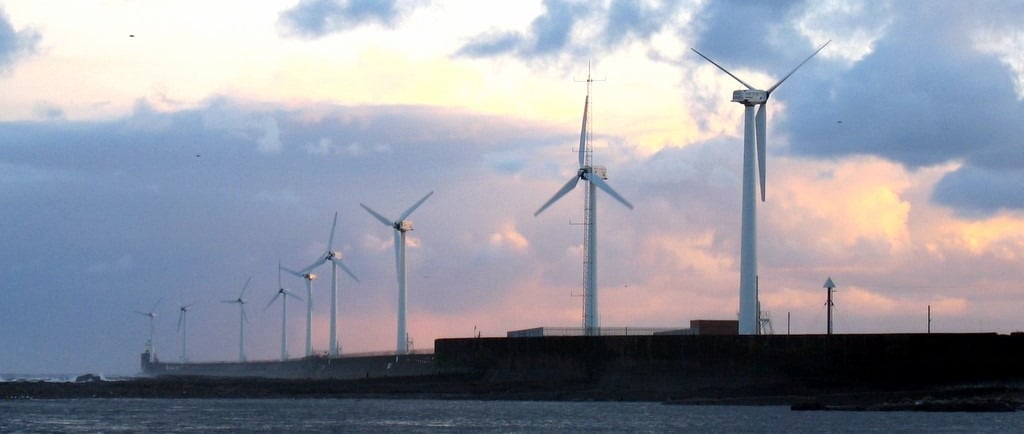
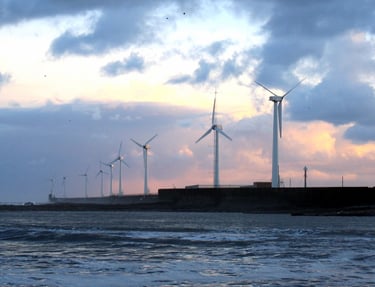
On 8 December 2000, 25 years ago to this week - two 2 MW Vestas turbines were commissioned 2 km offshore from Blyth Harbour in Northumberland (picture above is wharf-side) —the UK’s first true offshore wind farm, not an in-harbour or nearshore demonstration [1]. Standing in 6–11 m water depth on monopile foundations, they were deliberately placed beyond the breakwater to prove the concept in open marine conditions, generating enough clean power for around 3,000 homes in a grid dominated by coal and gas.
Twenty-five years later, those same North Sea winds drive over 15 GW of British offshore wind capacity, powering more than 15 million homes and contributing one-fifth of Europe’s electricity [2]. In the UK alone, cumulative offshore wind generation has exceeded 400 TWh since 2000, surpassing domestic gas-fired electricity for the first time in 2024 and avoiding the need for additional gas and coal imports that would have increased those fuel demands by 10% and 4%, respectively [6]. This has delivered substantial economic resilience: the sector has saved the UK at least £30 billion (in 2024 prices) on imported fuel costs to date, including an estimated £1 billion in avoided payments to Russia based on historic sourcing patterns [6].
When Vladimir Putin weaponised gas in 2022, slashing pipeline flows by 80% after Russia supplied 45% of the EU’s gas imports [3], Europe did not falter. Renewables like offshore wind accelerated, alongside demand reductions, collapsing Russian gas imports to 15% of EU supply—with the final pipeline contracts set to expire in 2027 [4]. Across the EU, wind and solar additions since 2021 have displaced around 38 billion cubic metres (bcm) of gas over three years, while total renewables-driven gas savings since 2022 exceed 60 bcm annually [7]. At prevailing prices, these reductions equate to tens of billions of euros in avoided import expenditures, fortifying energy security without compromising supply.
Technologically, costs have plunged nearly 70% in the past decade, enabled by larger turbines, standardised 66 kV inter-array cables, 220 kV AC export systems, and robust 400 VAC topside equipment in fixed AC configurations—the current standard for balance-of-plant efficiency [5]. Fixed-bottom farms now deliver near-baseload reliability; floating wind and hybrid AC-DC interconnectors promise further scalability into deeper waters.
Tree-huggers envisioned the green potential, engineers engineered the reliability, and policymakers secured the investments—yet the true victor is economic sovereignty. From Blyth’s modest proof-of-concept to a continent-sparing powerhouse, offshore wind has not only curbed emissions but also shielded wallets from fossil-fuel volatility.
So raise a pint to those two turbines properly offshore at Blyth: the original, very British middle finger to energy blackmail—and a £30 billion-plus toast to the savings they’ve spun.
Cheers to 25 years of English offshore wind.
[1] RenewableUK – 25 Years of UK Offshore Wind
[2] WindEurope Statistics 2025
[3] IEA – Europe’s Response to Russia’s Gas Cuts 2022
[4] Bruegel – The EU-Russia Energy Divorce
[5] WindEurope – Offshore Wind Cost Trends 2015-2025
[6] Energy and Climate Intelligence Unit – Offshore Wind Fuel Import Savings 2000-2025
[7] European Commission – REPowerEU Progress Report 2025
Contact
Prefer to call us directly, or send an email?
Phone
+39 331 802 9277 (Europe)
+1 281 932 6226 (USA)
© 2022 Renova Energy Solutions LLC. Registered in WY, USA. Operating from USA/Italy
All rights reserved.
Projects delivered in conformity with ISO 9001 quality management principles, DNV, and Lloyd's Register standards in renewable energy and marine sectors. [Learn more about us →]