
Subsea Electrical Architecture: The Quiet Revolution Facing U.S. Policy Headwinds
George Ralston
12/6/20252 min read
Offshore wind’s electrical backbone is shifting from massive topside platforms to fully subsea systems. Traditional fixed-bottom farms use 66 kV AC inter-array cables feeding 220–275 kV AC export via 1,000–3,000 tonne topside substations, costing €320–420 per kW installed. As projects move beyond 60 m depth and 100 km offshore, high-voltage direct current (HVDC) subsea topologies are taking over, reducing transmission losses by up to 45 % and electrical total installed cost to €160–210 per kW.
Key enablers are now commercial: 66 kV wet-mate connectors rated for 2,000+ cycles, pressure-tolerant 525 kV subsea converters (500–600 MW modules), and fibre-optic daisy-chain control that eliminates copper umbilicals. Projects such as Baltic Power (Poland, 2025) and the German 2 GW grid connections (2029–2031) are the first to award fully subsea HVDC hubs with single static export cables serving 1.5–2 GW clusters.
Globally, the direction is clear: by 2030 the majority of new capacity farther than 60 km from shore will be subsea HVDC.
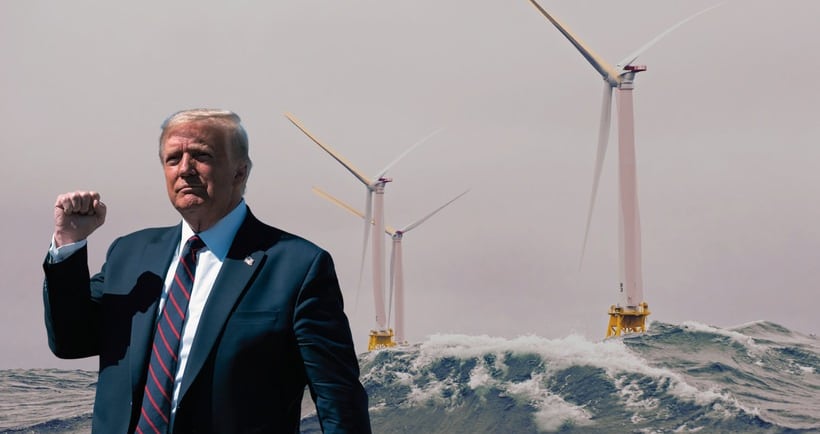
In the United States, however, momentum has stalled. On 20 January 2025, the incoming Trump administration issued Executive Order 14153 withdrawing all remaining Outer Continental Shelf areas from wind leasing and pausing all pending approvals. Permits for projects including New England Wind Phases 1 & 2 were revoked, and $679 million in port-upgrade grants rescinded. Approximately 19 GW of offshore wind in the approval pipeline is now frozen.
This decision profoundly affects subsea architecture deployment. While existing permitted projects like Sunrise Wind (924 MW offshore New York) and Revolution Wind (704 MW offshore Rhode Island) proceed with hybrid AC/DC designs, the freeze halts new leases, stalling investments in advanced subsea HVDC systems essential for deeper-water floating farms. Subsea tech, reliant on economies of scale from U.S. East Coast tenders, faces delayed commercialization—potentially shifting 5–10 GW of planned capacity to Europe, where TenneT's 2 GW hubs advance unhindered. Without U.S. demand, innovation in wet-mate connectors and seabed converters slows, raising global costs by 10–15 % short-term.
While Europe and Asia accelerate subsea standardisation, U.S. developers face renewed uncertainty. The technology to make offshore wind the cheapest new-build power source is ready — the question is where it will be deployed first.
References [1] Wind Europe, “Offshore Wind in Europe – Key trends and statistics 2024”, February 2025 [2] 4C Offshore, “Global Offshore Wind Electrical Infrastructure Benchmark 2025”, Q3 2025 update [3] ABB, “Subsea Power Systems – Qualification Summary 2025”, public brochure [4] TenneT & Energinet, “2 GW Standard Grid Connection Programme Update”, October 2025 [5] IEA, “Offshore Wind Outlook 2025–2050”, November 2025 [6] Federal Register, Executive Order 14153, 20 January 2025 [7] U.S. Department of the Interior, BOEM Press Release, 21 January 2025 [8] American Clean Power Association, “U.S. Offshore Wind Pipeline Report Q1 2025”
Contact
Prefer to call us directly, or send an email?
Phone
+39 331 802 9277 (Europe)
+1 281 932 6226 (USA)
© 2022 Renova Energy Solutions LLC. Registered in WY, USA. Operating from USA/Italy
All rights reserved.
Projects delivered in conformity with ISO 9001 quality management principles, DNV, and Lloyd's Register standards in renewable energy and marine sectors. [Learn more about us →]