
The Data Center Industry Has a Power Problem. It's About to Create a Worse One.
Behind-the-meter generation is the right answer to the wrong question. Building compute around energy availability — not users — may become the next major architectural mistake in AI infrastructure.
5/27/20262 min read
Everyone in the data center industry is talking about power. Who has it, who’s waiting years to get it, who’s building their own. The numbers justify the obsession: global data center electricity consumption hit 415 TWh in 2024 and is on course to nearly double by 2030. The grid cannot keep up. So hyperscalers are becoming energy developers — building gas turbines, signing nuclear deals, constructing private microgrids. Behind-the-meter power is the story of the moment.
But while the industry is focused on solving the power question, it may be creating a latency trap.
Behind-the-meter (BTM) generation naturally pulls compute toward locations chosen for their energy economics — remote renewable corridors, rural industrial zones, regions with cheap gas access. These choices make power sense. They often make poor network sense. And as AI inference becomes the primary mode through which AI creates commercial value, network position is no longer a secondary consideration. It is the ballgame.
“A data center that wins on power and loses on network position hasn’t solved the problem. It’s moved it.”
TRAINING VS INFERENCE — THE DISTINCTION THAT CHANGES EVERYTHING
AI training workloads are asynchronous. They run for days or weeks, tolerate geographic separation, and can sit wherever power and cooling are cheapest. That is the workload most people picture when they think about hyperscale AI infrastructure. It is also increasingly not the workload that matters most commercially.
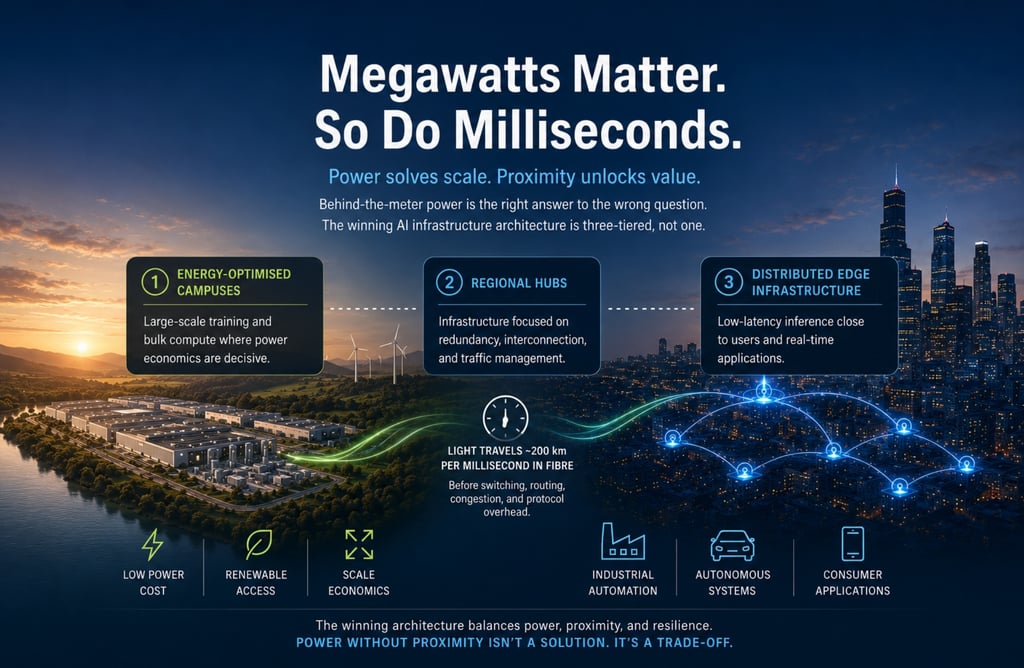
AI inference is different. It is synchronous, continuous, and proximity-constrained by physics. Light travels through fibre at roughly 200 kilometres per millisecond, before switching, routing, congestion, and protocol overhead are even considered. An inference application that needs a sub-10ms response cannot be served from a data centre several hundred kilometres away, no matter how efficiently that facility is powered. A factory automation platform, autonomous vehicle system, or AI-assisted industrial process cannot tolerate long-haul latency introduced by distant compute placement.
Much of the industry is still designing next-generation AI infrastructure around training economics rather than inference realities. But inference is where the revenue is, and inference has an address — it has to be near people.
THE RIGHT ANSWER: THREE TIERS, NOT ONE
This is not an argument against BTM power. It is an argument against treating power as the only variable. The architecture that actually works looks more like three distinct tiers:
Energy-Optimised Campuses
Large-scale training and bulk compute where geographic separation is acceptable and power economics are decisive.Regional Hubs
Infrastructure focused on redundancy, interconnection, and traffic management.Distributed Edge Infrastructure
Low-latency inference nodes positioned near users, industrial systems, and real-time AI-enabled applications.
Open infrastructure standards from the Open Compute Project are making distributed deployment cheaper. Vendors like Schneider Electric and Vertiv are building modular, prefabricated systems that can be deployed rapidly at any tier — from a remote BTM campus to a metro edge node. The building blocks already exist.
What is missing is the strategic discipline to use them correctly. The operators who treat compute placement, user proximity, and network resilience as co-equal constraints — not afterthoughts — will be the ones positioned for the inference era. The operators who optimise purely around power availability may find they have simply traded one bottleneck for another.
Megawatts matter. So do milliseconds.
Adapted from the Renova Energy Solutions technical insight paper: Behind-the-Meter Power for Hyperscale Data Centers: Strategic Advantage or Latency Trap? (2026).
Contact
Prefer to call us directly, or send an email?
Phone
+39 331 802 9277 (Europe)
+1 281 932 6226 (USA)
© 2022 Renova Energy Solutions LLC. Registered in WY, USA. Operating from USA/Italy
All rights reserved.
Projects delivered in conformity with ISO 9001 quality management principles, DNV, and Lloyd's Register standards in renewable energy and marine sectors. [Learn more about us →]