
The True Cost of Electrical Redundancy in Offshore Substations
George Raslton
12/6/20252 min read
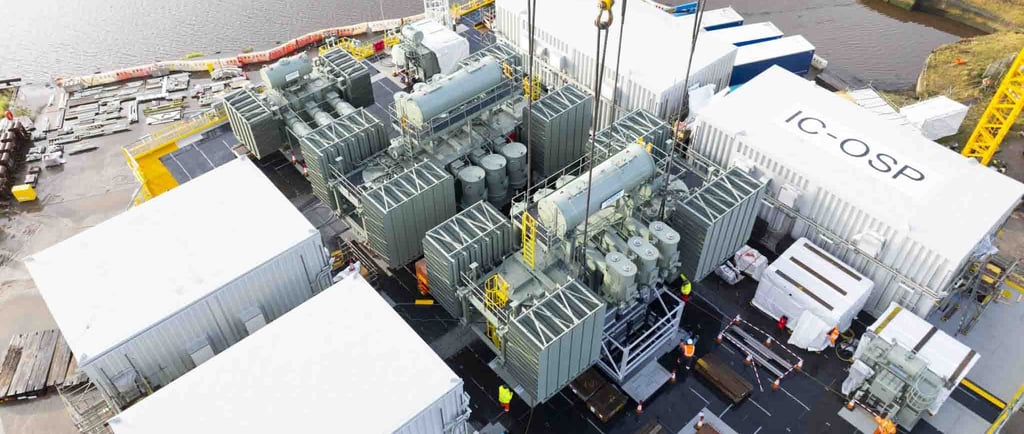
Electrical redundancy remains a cornerstone of reliability for offshore wind substations, where a single failure can halt gigawatts of renewable export. Typical configurations employ 66 kV inter-array cables and 220–275 kV export circuits operating in HVAC, with topside auxiliary systems at 400 V [1]. Yet achieving N-1 or N+1 redundancy—meaning the system remains operational after the loss of any single component—comes at substantial cost across the project lifecycle.
Capital expenditure forms the largest portion. A 2023 study of European round-3 and round-4 projects found that moving from no redundancy to full N-1 on the high-voltage side increases substation CAPEX by 18–28 %, driven primarily by duplicate 220 kV transformers (≈€12–18 million each installed offshore), additional GIS switchgear bays, and auxiliary systems [2]. Floating wind projects show even higher premiums because dynamic cables and floating platforms demand redundant emergency generators and UPS systems to maintain station-keeping during blackouts [3].
Installation and integration costs rise correspondingly. Redundant layouts require larger topside modules (typically +15–25 % deck area), heavier lifts, and extended offshore hook-up campaigns. DNV’s 2024 cost benchmark reports an average increase of €35–50 million per substation when specifying full redundancy [4].
Operational expenditure over 25–30 years adds further burden. Duplicate transformers left energized in standby consume 0.3–0.5 % of rated power as no-load losses, while annual maintenance of idle GIS bays and backup diesel generators adds ≈€1.2 million per platform per year [5]. Specialized competence for infrequent switchovers also commands premium salaries.
Despite these costs, full redundancy has prevented multi-hundred-million-euro revenue losses in several incidents. The 2021 Borssele Alpha transformer failure, for example, would have caused 184 days of zero export without its redundant sister transformer [6].
In summary, implementing N-1 electrical redundancy in a 1 GW-scale fixed offshore substation typically adds €80–120 million in net present cost (2024 euros) versus a non-redundant design. Whether this premium is justified depends on lost-production penalties, insurance terms, and regulatory requirements. As projects move farther offshore and scale beyond 2 GW, optimized partial redundancy schemes (e.g., shared spares across sister platforms) are gaining traction to balance reliability against cost.
References [1] 4C Offshore Database, 2025 [2] WindEurope, “Offshore wind substation costs 2023 cost study” [3] Carbon Trust Floating Wind JIP, Phase III report, 2024 [4] DNV, “Offshore Substation Cost Benchmarking 2024” [5] Ørsted internal OPEX data presented at WindEurope 2024 [6] TenneT post-incident report, Borssele Alpha, 2022 (public summary)
Contact
Reach out to George for expert energy advice
Phone
+39 331 802 9277
+1 281 932 6226
© 2016. All rights reserved.