
Why Interface Management Defines Success in Complex Energy Projects
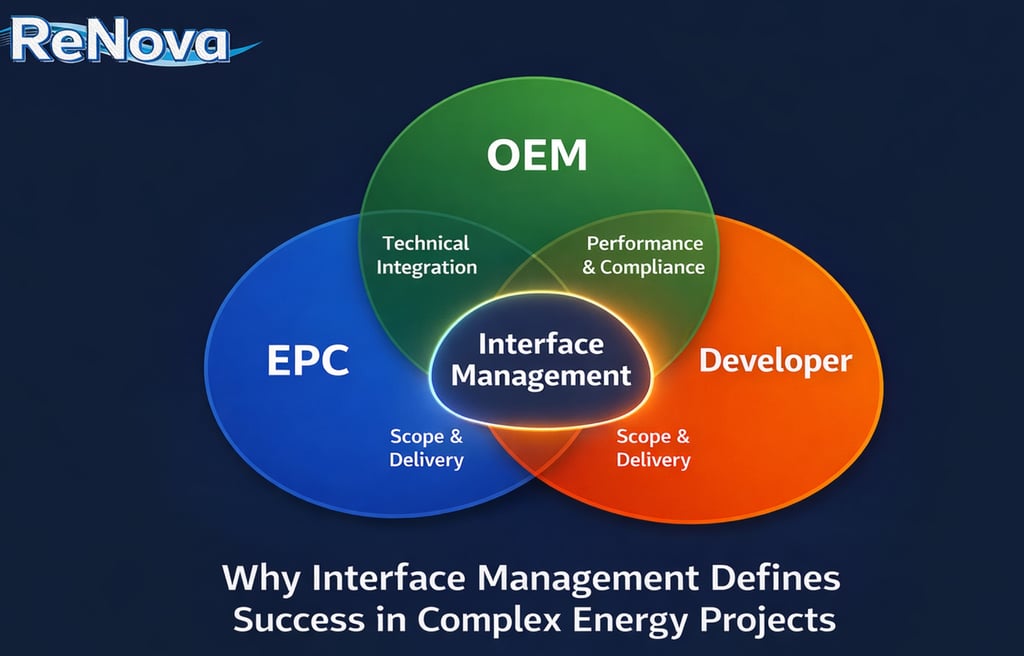
Interface management is critical to the success of complex energy projects involving EPC contractors, OEMs, and developers. This article explores how clear ownership, early coordination, and structured communication across interfaces can reduce risk, prevent delays, and ensure successful system integration and delivery.
George Ralston
3/24/20262 min read
Introduction
In today’s complex energy projects, particularly in offshore substations, renewable generation, and grid infrastructure, delivery rarely sits with a single entity. Instead, projects are executed through a combination of EPC contractors, OEMs, and developers, each bringing specialized expertise.
While this model improves technical capability and flexibility, it introduces one of the most underestimated risks in project delivery: interface management.
Poorly defined or managed interfaces can lead to delays, cost overruns, scope disputes, and even system failures. Yet, when handled correctly, interface management becomes a key enabler of efficient and predictable project execution.
What is Interface Management?
Interface management is the structured process of identifying, defining, tracking, and controlling interactions between different parties, systems, and scopes within a project.
In a joint delivery model involving:
EPC (Engineering, Procurement, Construction contractor)
OEM (Original Equipment Manufacturer)
Developer (Project owner or operator)
interfaces exist at multiple levels:
Technical (equipment, signals, power, control systems)
Commercial (scope boundaries, responsibilities)
Organizational (communication and decision-making)
The Three-Party Challenge
1. EPC Perspective
The EPC contractor is responsible for delivering the integrated system. However, they often depend heavily on OEM design inputs and developer requirements.
Key risks:
Misaligned specifications between OEM equipment and EPC integration
Late design changes from OEMs impacting construction schedules
Undefined battery limits
2. OEM Perspective
OEMs focus on delivering compliant, high-performance equipment — but not always on system-level integration.
Key risks:
Limited visibility of full project context
Assumptions about installation, cabling, or environmental conditions
Interface gaps in control systems, SCADA, or protection scheme
3. Developer Perspective
The developer ultimately carries the financial and operational risk.
Key risks:
Scope gaps between EPC and OEM falling back on the developer
Lack of transparency in interface ownership
Delays impacting revenue generation
Where Projects Go Wrong
Across projects, recurring interface failures include:
Undefined battery limits
Who supplies, installs, tests, and commissions?Cable and signal mismatches
Different assumptions on terminations, shielding, or routingControl system integration issues
SCADA, protection relays, and communication protocols not alignedDocumentation gaps
Missing or inconsistent interface registersLate-stage discoveries
Problems only identified during commissioning
Best Practices for Effective Interface Management
1. Early Interface Identification
Start during FEED or early design phases:
Define all physical, electrical, and functional interfaces
Involve EPC, OEM, and developer simultaneously
2. Clear Ownership and Responsibility
Every interface must have:
A single owner
Defined deliverables
Agreed timelines
Avoid “shared responsibility” — it often becomes “no responsibility.”
3. Interface Register
A live interface register is essential:
Tracks all interfaces
Assigns ownership
Records status and risks
Links to technical documentation
4. Standardized Communication
Regular interface meetings
Structured reporting
Clear escalation paths
5. Integration-Focused Engineering
System-level thinking is critical:
Not just “does it work?” but “does it work together?”
Validate interfaces through design reviews and simulations
6. Independent Interface Oversight
This is where specialized engineering support adds value.
An independent interface management function can:
Bridge gaps between EPC, OEM, and developer
Provide unbiased technical alignment
Reduce risk before it impacts schedule or cost
Why It Matters More Than Ever
As energy projects become more complex — particularly with:
Offshore wind
HVDC systems
Hybrid energy systems
Digitalized substations
…the number of interfaces increases exponentially.
Without strong interface management, complexity quickly turns into risk.
How Renova Energy Solutions Supports Interface Management
At Renova Energy Solutions, we support developers, EPC contractors, and OEMs by:
Establishing and managing interface registers
Defining technical boundaries and responsibilities
Supporting design coordination across stakeholders
Identifying and mitigating interface risks early
Providing independent engineering oversight
Our experience in complex energy infrastructure allows us to ensure that systems are not only designed correctly — but integrated effectively.
Conclusion
Interface management is not just a coordination task — it is a critical engineering discipline that directly impacts project success.
In EPC–OEM–Developer joint ventures, clarity at the interfaces determines whether a project runs smoothly or encounters costly disruptions.
Investing in structured interface management early is one of the most effective ways to reduce risk, protect schedules, and ensure successful project delivery.
Contact
Prefer to call us directly, or send an email?
Phone
+39 331 802 9277 (Europe)
+1 281 932 6226 (USA)
© 2022 Renova Energy Solutions LLC. Registered in WY, USA. Operating from USA/Italy
All rights reserved.
Projects delivered in conformity with ISO 9001 quality management principles, DNV, and Lloyd's Register standards in renewable energy and marine sectors. [Learn more about us →]