
Why Interface Management Is One of the Most Critical Disciplines in Offshore Wind
Interface management is critical to the successful delivery of modern offshore wind projects involving EPC contractors, OEMs, TSOs, and multiple technical disciplines. This article explores how credible design, stakeholder alignment, and execution-focused coordination help reduce risk, prevent delays, and ensure successful system integration and delivery.
George Ralston
3/24/20263 min read
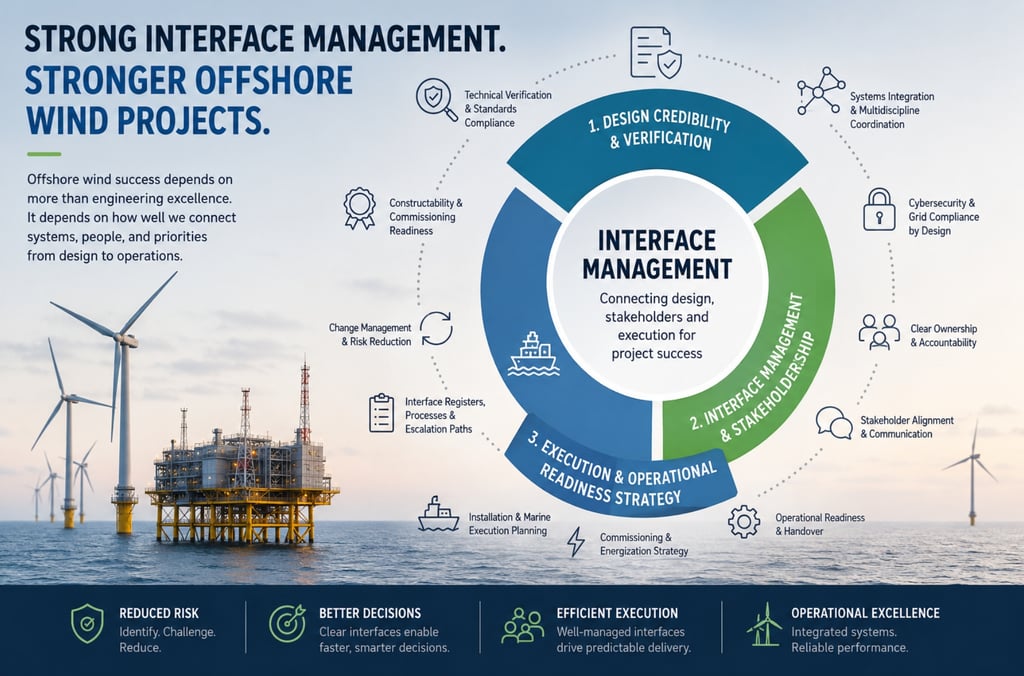
Modern offshore wind projects are no longer simple construction programs. They are highly integrated energy systems involving electrical infrastructure, digital platforms, marine operations, cybersecurity requirements, OEM coordination, grid integration, and increasingly complex operational architectures.
As offshore wind farms continue to grow in size and technical sophistication, interface management has become one of the most important disciplines in successful project delivery.
At Renova Energy Solutions, we see interface management as far more than document coordination or action tracking. Effective interface management sits at the center of project integration and directly influences engineering quality, stakeholder alignment, execution efficiency, commissioning readiness, and operational performance.
In our experience, successful offshore wind delivery consistently depends on three connected factors:
Credible design and verification
Integrated interface management and stakeholder alignment
Execution and operational readiness strategy
Interface management is the discipline that connects all three.
Offshore Wind Projects Are Becoming Increasingly Integrated
The offshore wind sector is evolving rapidly:
Larger turbines
More digitalized offshore substations
HVDC transmission systems
Advanced SCADA and telecom networks
Remote operations
Cybersecurity integration
Multi-contractor delivery models
Increasing grid code complexity
Every additional system, contractor, and operational dependency creates new interfaces across the project.
These interfaces exist between:
Wind turbine generators and foundations
Array cables and offshore substations
HVDC systems and TSOs
SCADA platforms and cybersecurity architecture
Marine installation contractors and commissioning teams
Electrical, structural, telecom, and operational system
Without disciplined interface management, these boundaries quickly become execution risks.
Interface Management Starts with Credible Design
Strong interface management begins during engineering development.
Credible design is not simply about producing calculations or drawings. It is about ensuring systems can be safely fabricated, installed, integrated, commissioned, operated, and maintained in real offshore conditions.
This requires:
Technical verification
Systems integration
Cross-discipline coordination
Constructability reviews
Grid compliance alignment
Cybersecurity integration
Lifecycle operability planning
As offshore assets become increasingly interconnected through digital systems, interface management plays a critical role in ensuring that engineering decisions remain aligned across all project packages.
This is particularly important for:
HVDC systems
Digital substations
Protection and control systems
SCADA infrastructure
IEC 62443 cybersecurity implementation
NIS2 compliance obligations
One of the most common industry challenges occurs when verification activities are compressed late into project execution. This often creates downstream impacts during FAT, SAT, energization, or offshore commissioning.
Strong interface management reduces this risk by maintaining continuous technical alignment throughout the project lifecycle.
Interface Management Is Also Stakeholder Management
In offshore wind, technical interfaces and organizational interfaces are closely connected.
Large projects involve:
Developers
EPC contractors
OEMs
TSOs
Marine contractors
Certification bodies
Regulators
Operations teams
Each stakeholder operates with different priorities, responsibilities, commercial drivers, and project pressures.
Strong interface management ensures alignment across:
Technical expectations
Scope boundaries
Installation planning
Energization philosophy
Risk ownership
Operational readiness
Decision-making responsibilities
Many offshore project challenges are not caused by engineering failure itself, but by unclear ownership, delayed decisions, or misalignment between stakeholders.
Effective interface management creates:
Faster decision-making
Better risk visibility
Improved contractor coordination
Stronger change management
Reduced rework
More efficient commissioning
In practice, interface management is both a technical and organizational discipline.
Strong Interface Management Requires a Systems Engineering Mindset
Modern offshore wind projects can no longer be managed as isolated engineering packages.
They must be managed as integrated operational systems.
This requires:
Whole-system thinking
Functional integration
Cross-package verification
Operational interoperability
Lifecycle coordination
Strong interface management therefore extends beyond physical connection points.
It also includes:
Signal mapping
Protection coordination
Telecom integration
Remote access architecture
Cybersecurity segmentation
Alarm management
Commissioning dependencies
Operational workflows
As offshore projects become more digitalized, systems integration becomes increasingly critical to long-term asset performance.
Interface Management Directly Influences Execution Strategy
Even strong engineering and aligned stakeholders can struggle without a realistic execution strategy.
Execution strategy defines how the project will actually be delivered offshore.
This includes:
Fabrication sequencing
Marine logistics
Installation methodology
Temporary works coordination
Energization planning
Commissioning philosophy
Offshore campaign management
Operational handover readiness
Interface management plays a central role in coordinating these dependencies.
Many offshore delays occur because systems were designed independently without fully considering:
Vessel constraints
Cable pull sequencing
Temporary power requirements
SAT dependencies
Offshore access limitations
Cybersecurity implementation timing
Operational integration needs
The strongest projects are commissioning-driven from the earliest stages of design.
This means understanding early:
How systems will be energized
How interfaces will be validated
How remote communication systems will operate
How cybersecurity controls will function
How the asset will ultimately be operated and maintained
Strong interface management ensures these considerations are integrated before offshore execution begins.
Risk Reduction Sits at the Center of Interface Management
Offshore wind projects operate within demanding technical, environmental, operational, and commercial conditions.
Project risks can emerge from:
Weather constraints
Marine operations
Supply chain delays
Grid compliance requirements
Contractor coordination
Installation sequencing
Cybersecurity integration
Operational readiness gaps
Strong interface management continuously identifies, challenges, and reduces these risks across the full project lifecycle.
This is one of the primary reasons interface management has become increasingly important across large offshore energy developments.
The Industry Direction Is Clear
The offshore wind sector is moving toward larger, smarter, and more interconnected infrastructure.
As this evolution continues, successful project delivery will increasingly depend on:
Integrated engineering
Cross-package coordination
Systems thinking
Operational readiness
Cybersecurity integration
Lifecycle reliability
Strong stakeholder alignment
Interface management is the discipline that brings these elements together.
Final Thoughts
In today’s offshore wind market, interface management is no longer an administrative support function.
It is a critical delivery discipline that directly influences:
Engineering quality
Stakeholder alignment
Execution certainty
Commissioning readiness
Operational performance
Overall project risk
At Renova Energy Solutions, we support developers, EPC contractors, OEMs, and asset owners with engineering support and integrated project coordination focused on reducing execution risk, improving commissioning readiness, and strengthening delivery performance across offshore energy projects.
As offshore wind projects continue to increase in complexity, strong interface management will increasingly define which projects succeed efficiently, and which struggle during execution.
Contact
Prefer to call us directly, or send an email?
Phone
+39 331 802 9277 (Europe)
+1 281 932 6226 (USA)
© 2022 Renova Energy Solutions LLC. Registered in WY, USA. Operating from USA/Italy
All rights reserved.
Projects delivered in conformity with ISO 9001 quality management principles, DNV, and Lloyd's Register standards in renewable energy and marine sectors. [Learn more about us →]