
Why Most Offshore Wind Teams Still Over-Spec Electrical Redundancy
Most offshore wind projects quietly bleed tens of millions on full N-1 electrical redundancy without running the lost-energy numbers first. Here’s the hard truth on what it really costs — and when to cut it back.
George Raslton
12/6/20252 min read
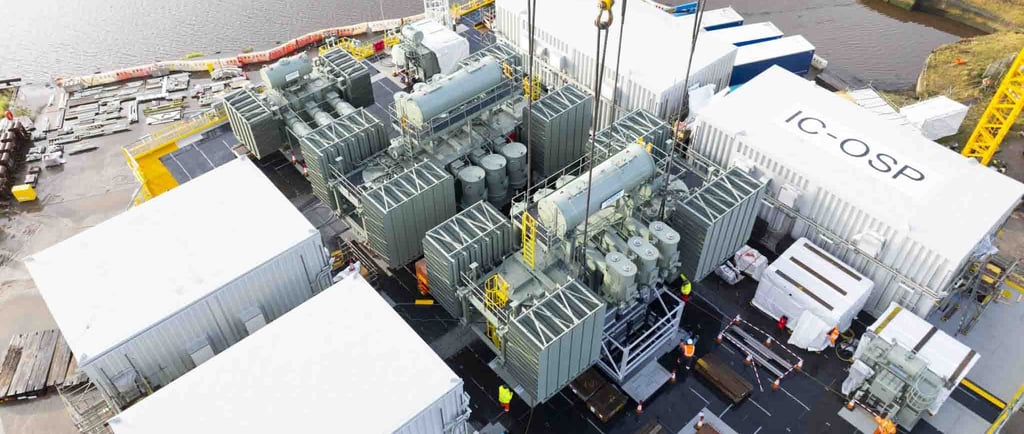
Most offshore wind developers still under-estimate the real price tag of full electrical redundancy in substations — and it’s quietly inflating project budgets by tens of millions.
I’ve seen too many teams chase N-1 compliance on every circuit without running the numbers first. The result? Ballooned CAPEX that squeezes margins when LCOE is already under pressure. Here’s the practical breakdown of what redundancy actually costs in today’s fixed-bottom and floating projects.
Capital Expenditure Shock: The Upfront Premium
Full N-1 redundancy on the high-voltage export side (typically duplicate transformers, GIS bays, and bus sections) drives the biggest hit.
Recent European benchmarks show this adds 18–30 % to substation topside CAPEX for a 1–2 GW platform. That translates to roughly €40–90 million extra per substation, dominated by:
Second 220–275 kV transformer + installation (~€15–25 M offshore)
Additional switchgear and protection relays
Larger jacket or floating foundation to carry the weight
Floating substations face even steeper premiums due to mandatory redundant dynamic-cable feeders and backup power for mooring thrusters.
Installation & Integration: The Hidden Timeline Killer
Redundant layouts demand bigger modules and more complex hook-up.
Expect +20–35 % deck space, heavier lifts, and extended offshore campaigns. Industry guides from 2025 report this pushes total installation cost up by €30–60 million per platform when full redundancy is specified early.
Many projects learn this the hard way during FEED: late-stage redesigns to strip non-critical redundancy can save millions but delay FID.
OPEX Reality Check: Standby Isn’t Free
Duplicate transformers in hot-standby still burn 0.3–0.6 % of rated power as no-load losses.
Add annual maintenance for idle GIS, backup diesels, and specialist switchover drills, and you’re looking at €1–2 million extra per year per substation over 25–30 years.
In high-windfall markets, this OPEX rarely breaks even unless you’ve suffered a major outage before.
Bottom Line: When Redundancy Pays — and When It Doesn’t
Full N-1 electrical redundancy typically adds €70–140 million (2025–2026 euros, NPV) to the lifecycle cost of a large fixed-bottom offshore substation versus minimal-redundancy designs.
It’s justified when lost production carries huge penalties (high market prices, strict offtake terms) or when regulatory bodies mandate it. Otherwise, partial redundancy — shared spares across sister platforms, N-1 only on critical paths, or risk-based transformer configurations — delivers 80–90 % of the reliability at half the premium.
Next time you’re in a design review, ask for the lost-energy-value calculation before signing off on duplicate kit. It changes the conversation fast.
Have you stripped redundancy on a recent project to hit budget? What worked — or backfired?
#OffshoreWind #WindSubstation #ElectricalRedundancy #RenewableEnergy #OffshoreEngineering
Contact
Prefer to call us directly, or send an email?
Phone
+39 331 802 9277 (Europe)
+1 281 932 6226 (USA)
© 2022 Renova Energy Solutions LLC. Registered in WY, USA. Operating from USA/Italy
All rights reserved.
Projects delivered in conformity with ISO 9001 quality management principles, DNV, and Lloyd's Register standards in renewable energy and marine sectors. [Learn more about us →]