
Cable Segregation in Offshore Substations: Where IEC 60533 Is Commonly Misapplied
Discover essential cable segregation techniques to prevent EMI, ensure safety, and comply with electrical standards. Cable segregation between power and data cables is critical for reliable installations in data centers and facilities.
RISK IDENTIFICATION & MITIGATION
George Ralston
12/13/20254 min read
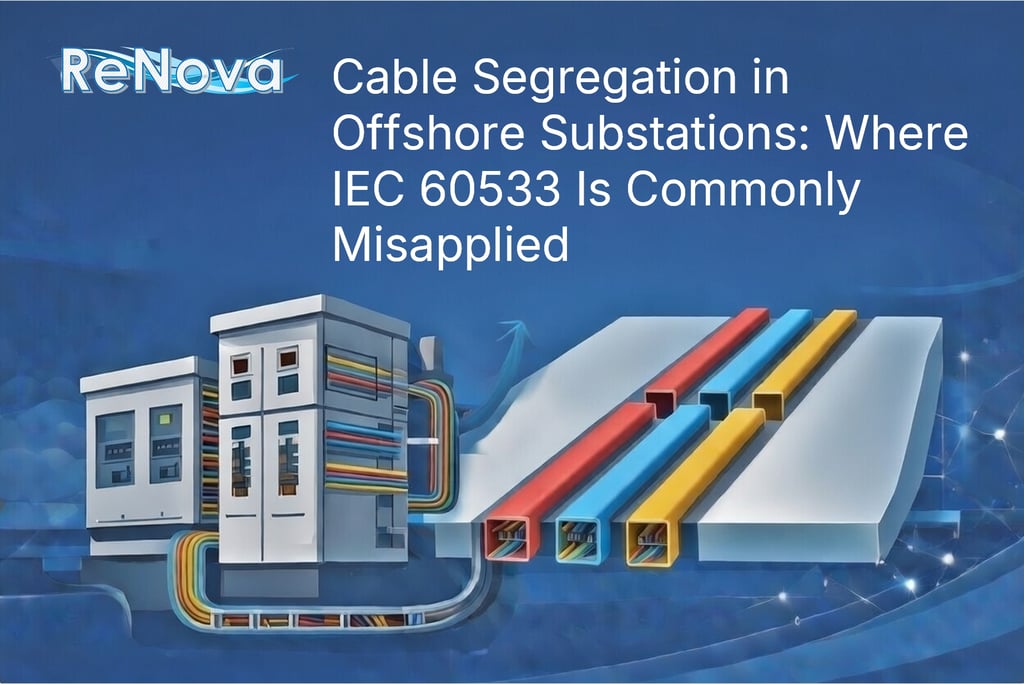
Cable segregation is one of the most frequently underestimated aspects of offshore substation design. In confined steel topsides, where high-power LV feeders run alongside sensitive signal, instrumentation, and fibre-optic cables, inadequate separation turns minor EMC vulnerabilities into major compliance and operational issues.
Across offshore wind projects, misapplication of IEC 60533 segregation rules has repeatedly led to noise induction, intermittent faults, or failed EMC verification during FAT or commissioning. These problems rarely stem from ignoring the standard entirely; they arise from inconsistent interpretation, deferred spatial enforcement, or assumptions that "close enough" separation suffices in a harmonic-rich environment.
When segregation philosophy is treated as a post-routing afterthought rather than an engineered requirement, the consequences appear late — when trays are full, penetrations fixed, and modifications become expensive.
The Technical Nature of the Problem
IEC 60533 (Electrical and electronic installations in ships and offshore units – Electromagnetic compatibility) defines cable categories and minimum separation requirements to limit electromagnetic interference in marine/offshore environments:
Category 1: High-power cables (e.g., LV power feeders > certain kW thresholds)
Category 2: Medium-power or shielded instrumentation
Category 3: Low-level signals, data, fibre, telecomms (most sensitive to noise)
The standard specifies separation distances, tray grouping rules, and breakpoint power levels where mixing becomes unacceptable without additional mitigation (shielding, filtering, barriers).
In offshore substations, the challenge is compounded by:
Harmonic distortion from converters and variable-speed drives
Switching transients from breakers
Confined tray space in risers and equipment rooms
Steel structure acting as a common reference plane
Common misapplications include:
Treating breakpoint power levels as absolute rather than context-dependent (e.g., ignoring cumulative harmonics)
Sharing trays between Cat 1 power and Cat 3 signals over long runs
Assuming shielded cables allow reduced separation without verifying shield integrity and termination
Inconsistent application across disciplines (electrical vs. instrumentation vs. telecomms)
Deferring segregation decisions until detailed routing, leading to last-minute compromises
These gaps create unintended coupling paths: inductive/capacitive crosstalk, common-mode currents, or radiated emissions that degrade signal integrity or trigger nuisance trips.
Where It Breaks Down in Practice
Segregation issues rarely appear during isolated vendor reviews. They emerge when packages converge in the 3D model or physical installation.
During FEED, philosophies may reference IEC 60533, but spatial allocation is often deferred. Tray philosophy documents exist, yet actual routing prioritises space over EMC.
In detailed design:
Electrical teams route LV power trays
Instrumentation teams place signal cables
Telecomms teams add fibre backbones
Each complies within scope, but integration reveals conflicts.
Repeatedly observed misapplications include:
Extended shared runs between Cat 1 LV feeders and Cat 3 fibre/instrumentation in risers
Reduced separation in congested areas justified by "shielded cable" without breakpoint analysis
Inconsistent shield termination (single-end vs. both-end grounding) across vendors
Tray grouping ignoring cumulative power levels from multiple circuits
A typical example from recent offshore wind substation deliveries involved Category 1 LV auxiliary power cables routed parallel to Category 3 SCADA and protection relay fibres in the same multi-level tray system over ~15 m in a vertical riser. The design referenced IEC 60533 separation guidelines, but the philosophy treated shielded instrumentation as sufficient mitigation without accounting for harmonic content from downstream converters.
During onshore FAT, noise on the fibre link manifested as intermittent packet loss under simulated load. Spectrum analysis showed conducted emissions peaks exceeding the expected compliance envelope due to inductive coupling. Onboard rework required tray segmentation, additional barriers, and partial rerouting — delaying sail-away by two weeks and adding engineering hours, though still far less costly than offshore discovery.
The root cause traced to deferred spatial enforcement of segregation before layout freeze; an earlier joint tray review would have enforced dedicated levels or separation at minimal cost.
The Commercial and Programme Consequence
Segregation rework rarely looks dramatic — no failed transformer or major equipment replacement. Yet it accumulates significant exposure:
Redesign and tray modifications onshore
Additional barriers, shielding, or rerouting
Extended FAT or re-testing cycles
Vendor claims for scope creep
Schedule compression into narrow weather windows offshore
In offshore projects, even small tray adjustments can disrupt sequencing of cable pulling, penetrations, and fire-stopping. If discovered offshore, costs escalate through vessel time, weather delays, and lost generation revenue.
Intermittent faults from poor segregation are particularly insidious: they may pass initial checks but appear under full operational harmonics, requiring time-consuming diagnosis during commissioning.
The impact is programme instability and eroded margin.
A Structured Prevention Approach
Preventing misapplication requires treating IEC 60533 as a spatial and philosophical requirement, not a checklist.
Practical measures that consistently reduce risk:
Define Segregation Philosophy at FEED Establish clear category definitions, breakpoint logic, and tray hierarchy before layout development. Document assumptions (e.g., harmonic levels, shield termination rules).
Enforce Spatial Compliance in 3D Reviews Conduct dedicated cross-discipline tray reviews before freeze. Verify separation distances, tray levels, and grouping against the philosophy — not just against vendor drawings.
Align Vendor Requirements Mandate consistent shield termination and category interpretation in package specifications. Require vendors to confirm compliance with the project philosophy.
Validate with Early EMC Assessment Use preliminary harmonic modelling or reference EMC binders to check cumulative effects on sensitive circuits. Adjust segregation where needed before procurement.
Document and Audit Maintain a traceable segregation matrix (cable ID → category → tray → separation justification). Audit during model reviews and FAT.
These steps require discipline, not additional hardware — and they shift risk from offshore to low-cost onshore stages.
Engineering-Led Risk Reduction
In offshore substations, cable segregation is not a secondary detail; it is fundamental EMC engineering in a confined, high-power environment.
Across projects, IEC 60533 misapplication rarely results from outright negligence. It stems from deferred decisions, inconsistent interpretation, and interface gaps between disciplines.
Early, structured enforcement of segregation philosophy — supported by spatial reviews and clear documentation — eliminates most late-stage EMC surprises. It protects signal integrity, reduces rework, and safeguards commissioning schedules.
Offshore environments leave little margin for unchallenged assumptions. Treating segregation as engineered intent rather than compliance box-ticking is a proportionate response to the platform's electromagnetic density.
This article is part of Renova's Offshore Substation Auxiliary Systems Risk Series, comprising:
Contact
Prefer to call us directly, or send an email?
Phone
+39 331 802 9277 (Europe)
+1 281 932 6226 (USA)
© 2022 Renova Energy Solutions LLC. Registered in WY, USA. Operating from USA/Italy
All rights reserved.
Projects delivered in conformity with ISO 9001 quality management principles, DNV, and Lloyd's Register standards in renewable energy and marine sectors. [Learn more about us →]