
Interface Risk in Offshore Substations: Why LV and ICT Fail Between Packages
Interface risk offshore substation causes LV and ICT failures between packages. Explore unclear boundaries, mismatched assumptions and redundancy gaps – plus early cross-package reviews to prevent integration surprises.
RISK IDENTIFICATION & MITIGATION
George Ralston
2/12/20263 min read
Offshore substations are delivered through multiple packages and vendors — primary HV equipment, protection & control, LV distribution, ICT/telecomms, HVAC, fire & gas, and more. LV and ICT systems sit at the intersection of these scopes, making them particularly vulnerable to interface gaps.
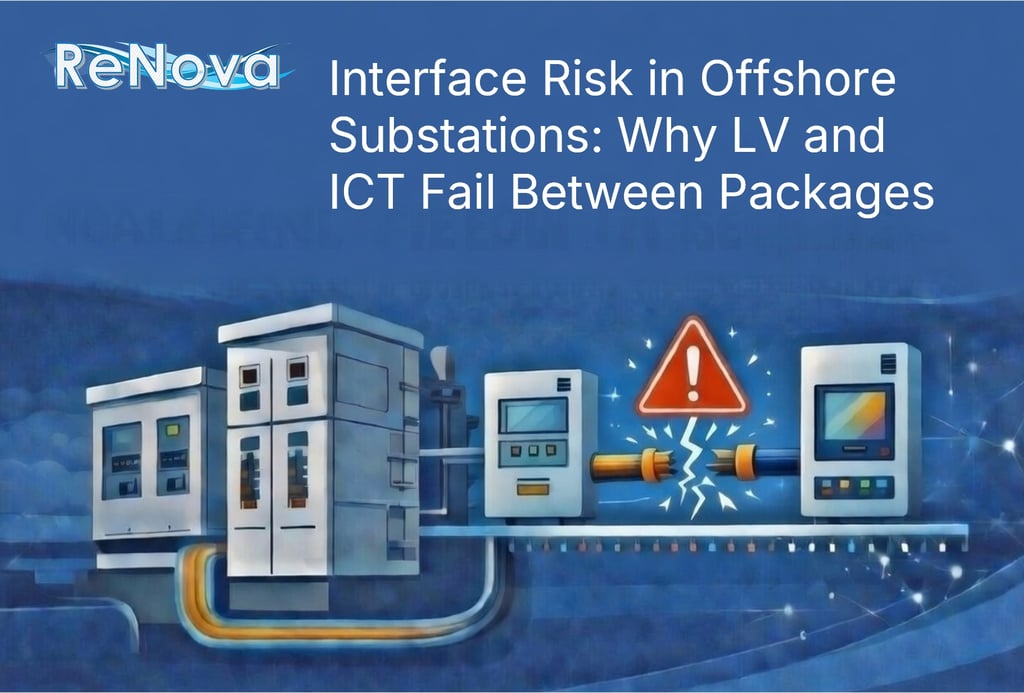
Across offshore wind projects, failures at package boundaries have repeatedly caused integration surprises during FAT, system commissioning, or early operations. These rarely result from poor individual package design; they stem from unclear battery limits, mismatched assumptions, and uncoordinated philosophies.
When interface ownership is diffuse or undefined, problems surface late — when equipment is installed, cables terminated, and modifications become disruptive and expensive.
The Technical Nature of the Problem
LV and ICT integration spans multiple vendors and disciplines, each with its own scope, standards, and assumptions. Common technical interface risks include:
Unclear battery limits — who supplies and sizes the UPS for auxiliary loads?
Mismatched fibre termination standards (e.g., LC vs SC connectors, single-mode vs multi-mode)
Conflicting grounding philosophies — isolated vs common reference, single-point vs multi-point
Inconsistent redundancy assumptions — A/B feeds, ring vs star topology, diverse routing
Duplicate or missing monitoring — SCADA points assumed by one package but not implemented
Vendor-specific protocols or configurations — incompatible time synchronisation, cybersecurity segmentation
Standards like IEC 61850 (substation automation), IEC 62439 (redundancy), and project interface matrices aim to control this, but in practice, interfaces are often described at high level in FEED and detailed late or inconsistently.
These gaps create latent failures: incompatible terminations, ground loops, loss of redundancy, or monitoring blind spots that only appear under integrated testing or operational load.
Where It Breaks Down in Practice
Interface issues typically hide until packages physically and electrically converge.
During FEED, interface registers may list high-level boundaries, but detailed responsibilities are deferred.
In detailed design and procurement:
HV/protection vendors define their LV needs
ICT/telecomms suppliers specify fibre and PoE requirements
LV distribution teams size boards based on assumed loads
Each package is compliant within its contract, but the integration risk lives in the gaps.
Repeatedly observed breakdown points include:
Conflicting UPS sizing or autonomy assumptions between LV and ICT packages
Fibre connector or wavelength mismatches at hand-over points
Grounding differences causing common-mode noise on shared references
Redundancy philosophies not aligned (e.g., one assumes diverse routing, another single path)
A typical example from recent offshore substation deliveries involved a protection & control package assuming LV UPS supply from the main auxiliary board (30 min autonomy), while the LV distribution package assumed a separate dedicated UPS (10 min) for non-critical loads. The interface matrix listed the boundary but did not specify sizing responsibility or diversity factors.
During integrated FAT, the UPS capacity proved insufficient under simulated peak load (protection relays + SCADA + PoE devices). Root cause required re-testing with additional battery modules and reconfiguration of feeders — adding three weeks to the schedule and variation costs. Offshore discovery would have required vessel-based modifications and extended commissioning.
The gap originated from an unclear ownership of the LV-UPS interface before procurement freeze; a dedicated cross-package interface review would have aligned assumptions early at negligible cost.
The Commercial and Programme Consequence
Interface failures rarely cause immediate catastrophe — no major equipment damage or blackout. Yet they accumulate significant exposure through:
Extended FAT or integration testing cycles
Hardware additions or reconfigurations
Vendor claims and variation orders
Schedule compression into weather-constrained offshore phases
Potential operational constraints (e.g., reduced monitoring visibility or redundancy)
Unresolved mismatches can lead to intermittent faults that are difficult to diagnose, diverting commissioning resources and eroding confidence.
The impact is programme instability, increased disputes, and reduced system robustness.
A Structured Prevention Approach
Mitigating interface risk requires treating boundaries as technical deliverables with clear ownership.
Practical measures that consistently reduce exposure:
Develop Detailed Interface Matrices Early Create a comprehensive register at FEED listing all LV/ICT touchpoints (power, data, grounding, redundancy). Assign ownership and responsibilities per interface.
Conduct Cross-Package Interface Reviews Hold dedicated alignment workshops before detailed design freeze and again before procurement. Verify assumptions, connector standards, grounding, and redundancy.
Mandate Consistent Philosophies Specify project-wide rules for fibre types, grounding, UPS autonomy, and cybersecurity segmentation in all package scopes.
Validate Through Mock-Ups or Simulations Use digital twins, loop diagrams, or early integration testing to expose mismatches before hardware commitment.
Audit and Lock Interfaces Maintain a traceable interface log with sign-off gates. Audit at FAT and pre-energisation.
These actions emphasise coordination and documentation — shifting risk to design stages where changes are low-cost.
Engineering-Led Risk Reduction
In offshore substations, LV and ICT systems depend on seamless integration across packages. Failures at boundaries are rarely due to technical incompetence; they result from diffuse ownership and unchallenged assumptions.
Early, structured interface management — supported by detailed matrices, cross-package reviews, and consistent philosophies — eliminates most integration surprises. It ensures compatibility, preserves redundancy, and protects commissioning schedules.
Offshore projects are too capital-intensive and time-sensitive to tolerate avoidable boundary failures. Treating interfaces as engineered deliverables rather than administrative notes is a proportionate response to the multi-vendor reality.
This article is part of Renova's Offshore Substation Auxiliary Systems Risk Series, comprising:
Contact
Prefer to call us directly, or send an email?
Phone
+39 331 802 9277 (Europe)
+1 281 932 6226 (USA)
© 2022 Renova Energy Solutions LLC. Registered in WY, USA. Operating from USA/Italy
All rights reserved.
Projects delivered in conformity with ISO 9001 quality management principles, DNV, and Lloyd's Register standards in renewable energy and marine sectors. [Learn more about us →]