
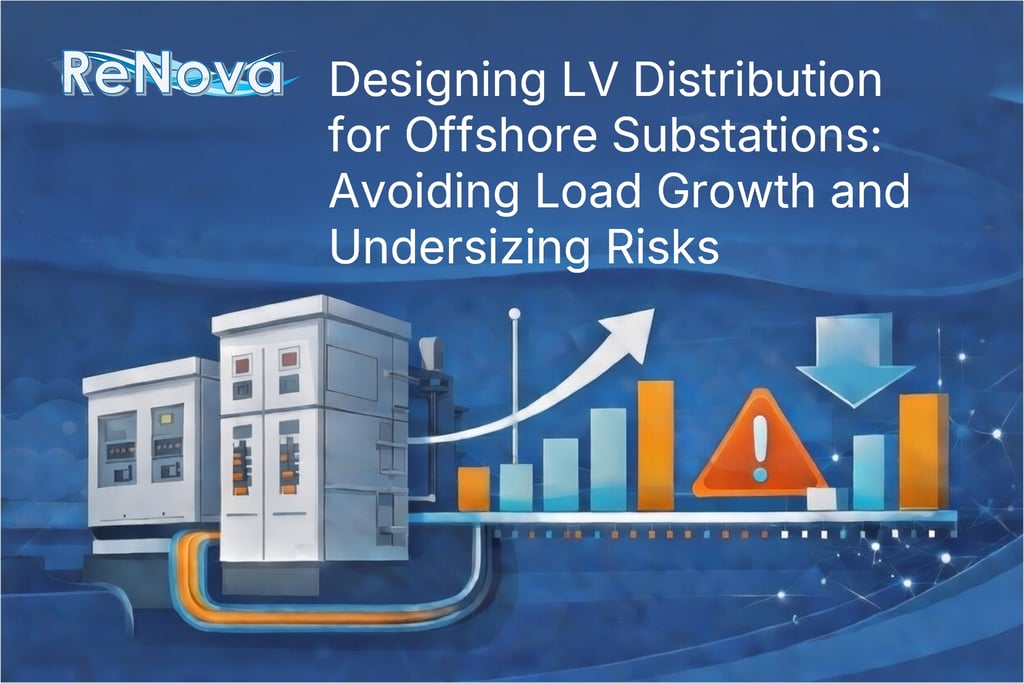
Designing LV Distribution for Offshore Substations: Avoiding Load Growth and Undersizing Risks
Designing LV offshore substation requires careful load validation to avoid undersizing and costly rework. Explore load growth risks, diversity assumptions and early cross-package reviews to ensure reliable auxiliary power.
RISK IDENTIFICATION & MITIGATION
George Ralston
2/5/20264 min read
LV distribution systems in offshore substations are deceptively simple. They supply auxiliary loads — HVAC, lighting, instrumentation, telecomms, small motors, and PoE devices — yet they are highly sensitive to changes in connected equipment and operational scenarios.
Across offshore wind projects, undersized or poorly validated LV boards have repeatedly led to overloads, nuisance trips, or failed discrimination during commissioning or early operations. These issues rarely result from basic design errors; they stem from incomplete load lists, late vendor data, optimistic diversity assumptions, and unvalidated spare capacity.
When LV distribution is treated as a static system rather than one subject to growth and variability, problems surface late — when panels are installed, cables pulled, and modifications require significant rework.
The Technical Nature of the Problem
LV distribution boards (typically 400/690 V, 3-phase) must handle connected loads with appropriate margins for future additions, diversity, and fault conditions. Key technical challenges include:
Incomplete auxiliary load lists — many loads (e.g., PoE switches, CCTV heaters, temporary test equipment) are finalised late
Diversity factor misuse — assuming low simultaneous use without verifying operational modes (e.g., maintenance, black-start)
UPS and battery assumptions — duplicate sizing across packages or mismatched autonomy requirements
Short-circuit and discrimination studies — based on preliminary data, leading to inadequate breaker coordination
Thermal and voltage drop margins — insufficient for harmonic heating or long cable runs in confined topsides
Standards like IEC 61439 (low-voltage switchgear assemblies) and project-specific philosophies require validated load schedules, but in practice, updates often occur after procurement freeze.
Common risk areas:
Overloaded outgoing feeders from added PoE or environmental monitoring loads
Nuisance tripping of breakers during inrush or peak diversity scenarios
Reduced discrimination causing cascading outages
Undersized busbars or cables leading to excessive heating
These issues are exacerbated in offshore environments where space constraints limit expansion and accessibility is limited.
Where It Breaks Down in Practice
Load validation gaps typically originate early and compound through design phases.
During FEED, auxiliary load lists are conceptual — based on P&IDs and vendor outlines. Detailed vendor data arrives later, often after board procurement.
In detailed design:
Electrical teams size boards on preliminary schedules
Instrumentation/telecomms teams add loads incrementally
HVAC and other auxiliaries update requirements
Each update may be minor, but cumulatively they exceed assumptions.
Repeatedly observed breakdown points include:
Late addition of PoE devices or redundant monitoring pushing feeders over rated capacity
Diversity factors applied optimistically (e.g., 0.6 instead of measured 0.85 in operational modes)
Inconsistent UPS assumptions between packages (e.g., one assumes 30 min autonomy, another 10 min)
Short-circuit levels underestimated, leading to poor breaker coordination
A typical example from recent offshore substation projects (≈1 GW wind farm scale) involved an LV distribution board sized for 80% utilisation based on FEED load list. Post-procurement, late vendor data for additional PoE switches, heated enclosures, and temporary test panels increased connected load by 25%. Diversity was initially assumed at 0.7 but proved closer to 0.9 during black-start simulation.
During onshore pre-commissioning, overload alarms triggered on multiple feeders under simulated peak conditions. Root cause analysis required load re-measurement, partial feeder reconfiguration, and breaker upgrades — delaying sail-away by 10 days and adding variation costs. Offshore discovery would have escalated to vessel time and extended commissioning.
The gap stemmed from insufficient cross-package load validation before procurement freeze; structured alignment of vendor data and operational scenarios would have identified the shortfall early.
The Commercial and Programme Consequence
LV undersizing rarely causes catastrophic failure — no major arc flash or total blackout. Yet it accumulates exposure through:
Onshore rework (breaker/fuse changes, busbar extensions)
Additional testing cycles
Vendor claims for out-of-scope modifications
Schedule compression into weather-limited offshore windows
Potential operational constraints (e.g., restricted simultaneous use of auxiliaries)
Intermittent overloads or poor discrimination can delay energisation, divert resources, and erode confidence in auxiliary reliability.
The impact is programme instability, increased variation orders, and reduced operational flexibility.
A Structured Prevention Approach
Avoiding load growth risks requires treating LV distribution as a living system with rigorous validation.
Practical measures that consistently reduce exposure:
Build Comprehensive Load Schedules Early Create a master auxiliary load list at FEED, updated iteratively with vendor data. Include diversity scenarios (normal, maintenance, black-start).
Conduct Cross-Package Load Reviews Hold dedicated alignment meetings before procurement freeze. Verify connected loads, diversity, and redundancy assumptions across disciplines.
Apply Conservative Margins and Validate Use 20–30% spare capacity on boards/feeders. Perform preliminary short-circuit/discrimination studies on updated data.
Model Operational Scenarios Simulate peak diversity and inrush using tools or reference data. Adjust sizing where needed before hardware commitment.
Document and Lock Assumptions Maintain a traceable load matrix (load ID → category → diversity → feeder assignment). Audit at key gates.
These actions require coordination and discipline — not oversized hardware — and shift risk to low-cost design stages.
Engineering-Led Risk Reduction
In offshore substations, LV distribution is the backbone of auxiliary reliability. It supports everything from control systems to life-safety equipment.
Across projects, undersizing issues rarely arise from poor component selection. They result from incomplete data, unchallenged assumptions, and interface gaps.
Early, structured load validation — supported by cross-package alignment and scenario modelling — eliminates most late-stage overload surprises. It protects board integrity, ensures discrimination, and safeguards commissioning schedules.
Offshore platforms leave little room for growth surprises. Treating LV distribution as dynamic and validated from FEED onward is a proportionate response to the project's capital intensity and operational demands.
This article is part of Renova's Offshore Substation Auxiliary Systems Risk Series, comprising:
Contact
Prefer to call us directly, or send an email?
Phone
+39 331 802 9277 (Europe)
+1 281 932 6226 (USA)
© 2022 Renova Energy Solutions LLC. Registered in WY, USA. Operating from USA/Italy
All rights reserved.
Projects delivered in conformity with ISO 9001 quality management principles, DNV, and Lloyd's Register standards in renewable energy and marine sectors. [Learn more about us →]