
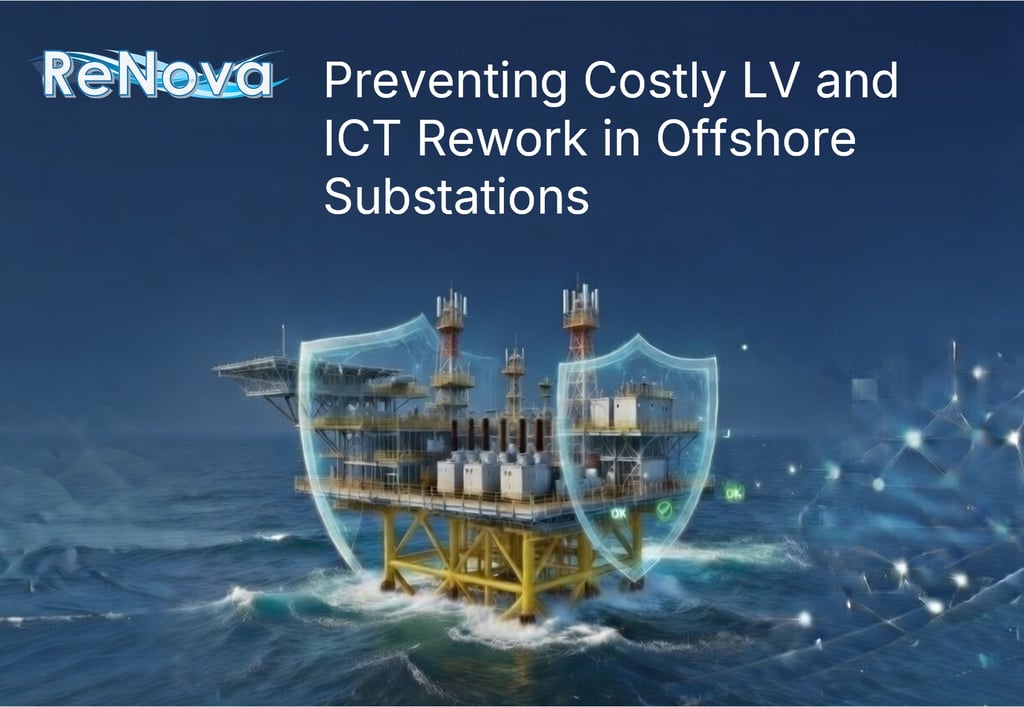
Preventing Costly LV and ICT Rework in Offshore Substations
LV ICT integration offshore wind substations often causes costly rework and delays. Explore segregation, grounding and interface pitfalls — plus early cross-discipline reviews to prevent them
RISK IDENTIFICATION & MITIGATION
George Ralston
2/6/20264 min read
In offshore substation projects, major electrical equipment rarely causes the most disruption during commissioning. Transformers, switchgear and primary protection systems are typically well specified, factory tested and tightly managed. The problems that delay energisation are often smaller, quieter and distributed throughout the platform — LV distribution, ICT systems and their integration.
Across multiple offshore developments, segregation conflicts, grounding inconsistencies and interface ambiguities have repeatedly surfaced during FAT, installation or late commissioning. By that stage, cable trays are installed, panels are wired and physical access is restricted. What could have been resolved during design becomes offshore rework.
In high-value offshore projects, auxiliary systems do not fail because of component quality. They fail because integration risk was underestimated early.
The Technical Nature of the Problem
Offshore substations are dense electromagnetic environments. High-voltage equipment, harmonic-rich converters, protection systems, communication networks and control circuits operate within confined steel structures.
LV and ICT systems must coexist with:
Power cables carrying significant load and fault currents
Switching transients from breakers
Harmonics generated by power electronics
Large structural steel acting as a conductive reference
Segregation, bonding and routing are not aesthetic decisions. They are electromagnetic compatibility decisions.
Standards such as IEC 60533 provide guidance on segregation between power and signal cables. However, in practice, segregation is often reduced to a compliance checklist rather than treated as an engineered spatial strategy.
Typical technical risk areas include:
Shared tray routing between LV power and shielded twisted pair instrumentation
Improper or inconsistent termination of cable shields
Mixed bonding philosophies between packages
Lack of clarity around Lightning Protection Zones within steel structures
Undefined interface responsibility between electrical and telecom scopes
Individually, these issues are manageable. In combination, they create unpredictable behaviour — particularly when systems are energised under real operating conditions.
Experience shows that many auxiliary integration problems are not visible during isolated design reviews. They emerge only when multiple packages are physically and electrically combined.
Where It Breaks Down in Practice
Most LV and ICT rework originates not in fundamental design incompetence, but in interface fragmentation.
During FEED, auxiliary systems are often defined functionally but not spatially. Cable philosophies are described, yet tray allocation and segregation hierarchy are deferred to later stages.
During detailed design, different vendors or engineering teams develop:
LV distribution boards
SCADA and telecom cabinets
Fire and gas systems
Navigation and aviation systems
Each package is compliant within its contractual boundary. The integration risk sits between boundaries.
Repeatedly observed breakdown points include:
Cable tray congestion forcing mixed routing late in the design cycle
Shielded cable bonding philosophies differing between vendors
ICT cabinets positioned adjacent to LV switchboards without defined EMC separation
Earthing concepts developed independently for power and telecom systems
These conflicts often remain latent until FAT or installation. At that stage, resolving them requires redesign, physical modification or negotiated deviation.
Offshore installation magnifies the impact. Tray modifications, additional gland plates, rerouting and retrofitted shielding become time-sensitive activities executed in constrained environments.
The Commercial and Programme Consequence
Auxiliary rework rarely appears dramatic in project reporting. It does not resemble a transformer replacement or major equipment failure.
Instead, it accumulates through:
Additional offshore man-hours
Extended commissioning sequences
Vendor variation orders
Interface disputes
Schedule compression pressure
In offshore wind and platform electrification projects, installation vessels and commissioning teams operate within narrow weather windows. Even minor electrical rework can disrupt tightly sequenced activities.
Intermittent communication faults caused by grounding or segregation inconsistencies are among the most time-consuming issues to diagnose. They frequently appear only once systems are operating under load, creating uncertainty at precisely the moment stability is required.
The cost is not simply materials. It is programme instability, resource diversion and reduced confidence during energisation.
A Structured Prevention Approach
The solution is not additional paperwork. It is earlier engineering alignment and clearer interface ownership.
Several practical measures consistently reduce LV and ICT integration risk:
Define Cable Segregation Strategy Early Segregation should be spatially defined during design development, not left to routing convenience. Clear tray categorisation and separation rules prevent late congestion and compromise.
Align Shielding and Bonding Philosophy Across Packages All vendors must follow a coordinated approach to shield termination and earthing. Mixed philosophies introduce unintended current paths and unpredictable EMC behaviour.
Establish Clear Lightning Protection Zoning Within Steel Structures Although offshore substations are constructed in steel, internal zoning remains essential. Without defined zones, bonding and equipment protection strategies vary between disciplines.
Integrate Cross-Discipline Reviews Before Layout Freeze Joint review of cable block diagrams, tray routing and cabinet positioning before layout freeze consistently proves more effective than late-stage compliance verification.
Assign Interface Ownership Integration boundaries must have clear technical ownership. Where responsibility is diffuse, integration risk persists unnoticed.
These actions are not complex. They require coordination discipline and early technical scrutiny rather than additional hardware.
Engineering-Led Risk Reduction
In offshore substations, auxiliary systems form the nervous system of the platform. They carry data, control logic, protection signals and operational visibility. When they malfunction, the root cause is often integration, not equipment defect.
Across projects, LV and ICT rework is rarely the result of a single major error. It is the cumulative effect of small, unchallenged assumptions at package interfaces.
Early, structured review of cable routing, segregation hierarchy, bonding philosophy and interface definition significantly reduces late-stage disruption. It also limits friction between vendors and protects commissioning schedules.
Offshore projects are too capital-intensive to allow avoidable auxiliary rework to erode margin or operational confidence.
Engineering-led integration review during design is not an optional refinement. It is a proportionate response to a dense and high-consequence electrical environment.
This article is part of Renova's Offshore Substation Auxiliary Systems Risk Series, comprising:
Contact
Prefer to call us directly, or send an email?
Phone
+39 331 802 9277 (Europe)
+1 281 932 6226 (USA)
© 2022 Renova Energy Solutions LLC. Registered in WY, USA. Operating from USA/Italy
All rights reserved.
Projects delivered in conformity with ISO 9001 quality management principles, DNV, and Lloyd's Register standards in renewable energy and marine sectors. [Learn more about us →]