
ICT Architecture in Offshore Substations: Designing for Redundancy, Resilience and Cyber Separation
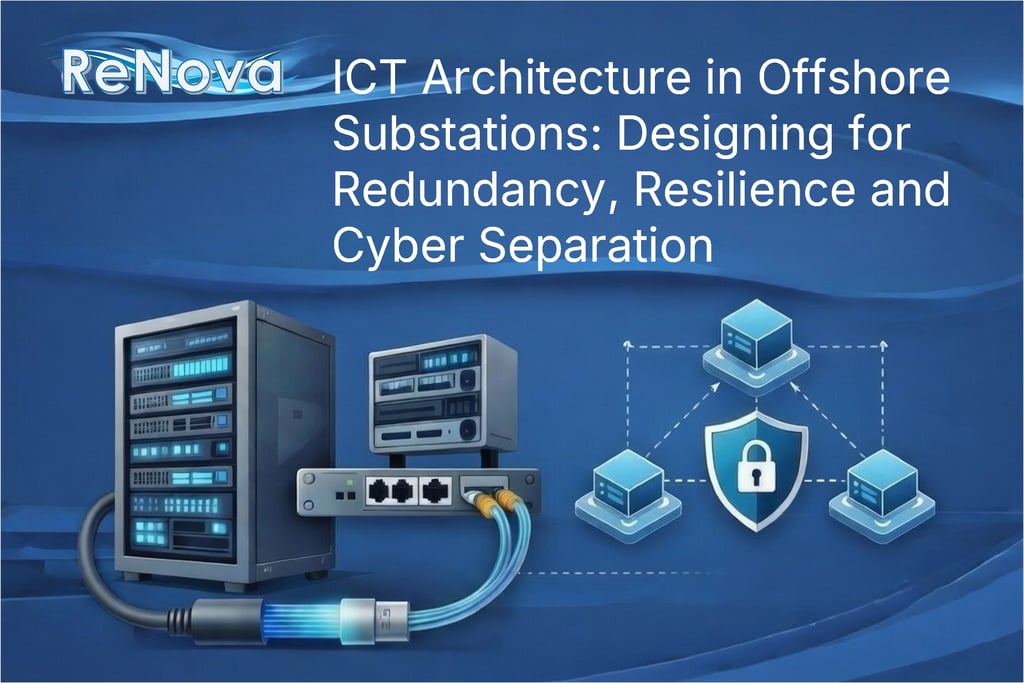
ICT architecture offshore substation requires redundancy, physical resilience and cyber separation. Explore risks in network topology, PoE loads and OT/IT isolation – plus early design strategies to ensure reliability.
RISK IDENTIFICATION & MITIGATION
George Ralston
12/31/20253 min read
Offshore substations are no longer purely electrical assets. They are data-driven operational platforms where protection systems, SCADA, condition monitoring, CCTV, access control and remote diagnostics depend on a resilient ICT backbone.
In many projects, ICT architecture is defined late — after electrical layouts freeze and vendor packages are partially locked. The result is a network that functions but lacks true redundancy, physical resilience or clear cyber separation between IT and OT domains.
Across offshore wind developments, these gaps have repeatedly surfaced as single-point failures during commissioning, reduced availability in operations, or heightened cyber exposure. Treating ICT as auxiliary rather than mission-critical infrastructure increases risk in a remote, high-consequence environment.
The Technical Nature of the Problem
Modern offshore substations support data-intensive functions:
SCADA and protection relays (IEC 61850 GOOSE/SV)
Redundant fibre backbones for control and monitoring
PoE-powered field devices (CCTV, sensors, access readers)
Cybersecurity segmentation (OT vs IT zones)
Time synchronisation (PTP/NTP) across systems
Key architectural challenges include:
Redundancy philosophy — ring vs star vs mesh topologies, diverse routing
Physical resilience — cable routing to avoid single-point damage (e.g., fire, mechanical impact)
Cyber separation — logical/physical isolation between enterprise IT (office, remote access) and operational technology (protection, SCADA)
PoE load management — thermal and power budgeting in confined racks
Network topology — top-of-rack switching, leaf-spine or hierarchical
Standards like IEC 62439 (redundancy), IEC 62443 (cybersecurity), and IEEE 802.3bt (PoE++) provide guidance, but implementation is often inconsistent across vendors.
Common pitfalls:
Single fibre path for critical links
Inadequate OT/IT segmentation allowing lateral movement
Overloaded PoE switches causing device dropouts
No diverse routing for A/B networks
These vulnerabilities manifest as loss of visibility, delayed alarms, or cyber entry points.
Where It Breaks Down in Practice
ICT architecture gaps emerge when packages converge without unified philosophy.
During FEED, high-level SCADA and telecomms requirements are noted, but topology and redundancy are deferred.
In detailed design:
Protection vendors specify GOOSE networks
Telecomms teams design fibre backbones
ICT integrators add PoE and CCTV
Each complies locally, but overall resilience suffers.
Repeatedly observed issues include:
Single-path fibre routing for SCADA links
Blurred OT/IT boundaries in shared switches
Insufficient PoE budget leading to device instability
No physical diversity for redundant networks
A typical example from recent offshore substation projects involved a fibre backbone designed as a single ring for SCADA and protection data. Redundancy was assumed via protocol-level failover (e.g., PRP/HSR), but physical routing followed the same cable tray system without diverse paths. The design referenced IEC 62439 but did not enforce spatial separation.
During commissioning, a mechanical incident (tray damage during final fit-out) severed the ring, causing loss of multiple SCADA links and delayed protection signalling. Root cause required temporary bypass cabling and partial re-routing — adding 2–3 weeks to handover and significant engineering costs. Offshore occurrence would have risked extended downtime.
The gap stemmed from deferred physical redundancy planning before routing freeze; an earlier topology review with diverse path requirements would have mitigated it at low cost.
The Commercial and Programme Consequence
ICT failures rarely cause immediate shutdowns — substations have fallback modes. Yet they accumulate exposure through:
Extended commissioning for redundancy verification
Additional cabling or switch upgrades
Vendor claims for scope creep
Reduced operational reliability (e.g., delayed remote diagnostics)
Heightened cyber risk surface leading to compliance rework
Intermittent dropouts or single failures erode confidence and divert resources.
The impact is programme delay, increased variation, and compromised long-term availability.
A Structured Prevention Approach
Resilient ICT requires treating it as critical infrastructure from early design.
Practical measures that consistently reduce risk:
Define Redundancy Philosophy Early Establish topology (e.g., dual rings with diverse routing) and protocol (PRP/HSR) at FEED. Document physical diversity requirements.
Enforce OT/IT Segmentation Design clear zones with firewalls, VLANs, and physical separation. Align with IEC 62443 levels.
Validate PoE and Thermal Loads Model power budgets and heat dissipation in racks. Specify industrial-grade PoE switches with margin.
Integrate Topology Reviews Conduct cross-discipline reviews of fibre routing and switching before layout freeze. Verify diversity and resilience.
Document and Test Maintain a traceable ICT architecture matrix (link ID → redundancy → cyber zone). Validate through simulations and FAT.
These steps focus on early coordination — shifting risk to design phases.
Engineering-Led Risk Reduction
In offshore substations, ICT is the nervous system enabling visibility, control and protection. Malfunctions rarely stem from device quality; they result from underestimated resilience and segmentation.
Early, structured architecture design — supported by redundancy philosophy, OT/IT separation, and physical diversity — eliminates most single-point failures. It ensures availability, limits cyber exposure, and protects operational schedules.
Offshore assets operate remotely in harsh conditions. Treating ICT as engineered critical infrastructure rather than auxiliary is a proportionate response to modern substation demands.
This article is part of Renova's Offshore Substation Auxiliary Systems Risk Series, that comprises:
Contact
Prefer to call us directly, or send an email?
Phone
+39 331 802 9277 (Europe)
+1 281 932 6226 (USA)
© 2022 Renova Energy Solutions LLC. Registered in WY, USA. Operating from USA/Italy
All rights reserved.
Projects delivered in conformity with ISO 9001 quality management principles, DNV, and Lloyd's Register standards in renewable energy and marine sectors. [Learn more about us →]